Thursday, November 21, 2013

Apple Crisp

Windfall apples from our tree gathered on the railing outside our front door


Branches weighted down with fruit

This year the old apple tree in front of our house produced a bumper crop of big, green apples. The branches were loaded and heavy with the weight of fragrant, ripe fruit. Shaking the tree produced a shower of runaway apples splattering on our heads and rolling down the stairway to our front door. At night I could hear distinct thuds as apples took the steps one at a time and rolled to the hillside below. 


Sun- burnished apples on a hazy day

Never had this tree offered so much fruit, and never had I been tempted to bake with its bounty. This was the year! Even though the apples were bright green, they were tart-sweet and firm-fleshed, not sour or hard as I had expected. They had never been this sweet and crisp and thoroughly delicious. I am not sure of the variety, but they resembled Granny Smiths, and Granny Smiths make wonderful baking apples. So, I went to work on an apple crisp


Our own apples, ripe and ready to fall

I gathered eight or nine unblemished apples,and prepared to peel them. But first I made the topping. I dug out my Aunt Haiya's faded recipe from my file, double checked with Deborah Madison's instructions in Vegetarian Cooking for Everyone and mixed the  ingredients in the food processor. I always add a cup of oats to the original topping to create a more textured and healthy dessert. 


Unfortunately, baking with apples usually requires peeling them, and this tedious process must be done by hand. At least Green Bin gets the leftover peels and cores.  I filled my baking pan with sliced, peeled apples, sugared them lightly, covered them with the topping and baked them in a 375 degree oven.


Baked apple crisp cooling in an Emile Henri oval baker from France

I could hardly wait to try my home-grown dessert. After it browned and bubbled I removed it from the oven and let it cool a bit. Then I sampled. Here's the verdict: The crisp was great, but  I was disappointed with the baked apples. They were monotonous and bland and lacked the creamy texture I prefer. Maybe they aren't Granny Smiths after all. Still, I wanted to try another dessert with apples from our tree.


Yellow leaves from our apple tree on the stairway

For the past several weeks I've been sweeping yellow leaves from the steps going down to our apartment. They were dropping steadily from the apple tree, along with the ripe apples which clunked down the stairs. I'd often eat the apples or set them on the railing ready to be hurled at raccoons bold enough to come near the house at night. Most were already half eaten by pesky squirrels. I haven't noticed deer devouring them, which is odd since they walk up and down the steep stairway regularly, searching for appetizing vegetation. Today, searching for apples, I looked up into the tree and to my surprise and shock, it was completely bare. Not one apple remained. I have no idea when or how all the apples disappeared, but I know they weren't blown down, since there are none on the ground or on the stairs. I rescued a few from inside pots or hiding under plants, but that's it! My personal supply is gone.

 Suddenly the apples are gone and the bare branches permit a clearer view of Euclid Ave below

Was it a hungry forager? If so he would have had to bring a ladder to get to most of the apples. I did notice someone in Tilden Park gathering all the blackberries this year, which has not occurred in the past. I  couldn't enjoy a blackberry treat while on my bike, because all the berries were picked over. From my observations, squirrels only nibble and then leave most of the apples on the ground. They aren't greedy. So who could clean up the tree so completely?

For my next crisp I had to visit the Monterey Market and buy apples.I chose winesaps and braeburns which I have enjoyed before. Now it would be fun to compare these with my own fruit. My favorite variety is actually Jonathon for both eating and baking, but they weren't available this season. Jonathons have an intoxicating fragrance and flavor that I can't resist— the very essence of autumn. But I was curious to see how the braeburn/winesap combo would fare.

Winesaps and Braeburns from the Monterey Market

 Luckily I still had some topping in the fridge, left over from the first batch, so all I had to do was peel, core and slice the apples, share with my Green Bin and wait about 40 minutes for the crisp to bake. After barely letting it cool I dove in. The result was sublime! This combination of apples definitely produced a superior crisp: flavorful, complex and balanced, not bland and lackluster like the apples from my tree. But I enjoyed harvesting and baking with my own apples and would have continued using them if my supply had not been so suddenly cut off. I'll have to wait until next year to try again. And I'll have a year to solve the mystery of the missing apples.


Saturday, October 19, 2013

Highlights of a Trip to Kaua'i

Partial view of  Hanalei Bay Resort's most beautiful pool
Another view of the pool where we swam daily

Kayaking the Hanalei River

 Headquarters of Kayak Kauai on the Hanalei River, from a previous trip


Dragon fruit at Kilauea farmers' market

Recycling Center in Princeville not far from our condo


Queen's Bath, a natural pool refreshed by the sea. Many fish make for remarkably good snorkeling.  


Dean swimming in Queen's Bath, which is calm here but treacherous in winter


Enjoying the Limahuli Gardens

Terraced hillside with taro at Limahuli Gardens


Hibiscus in Limahuli Garden


View of Bali Hai from our room at Hanalei Bay Resort

Surfer and dog at Tunnels Beach, not far north of our condo

Clouds over Bali Hai, seen from our lanai

Kauai rainbow from our parking lot

Pleasures not pictured

Macadamia Nut Tart...
homemade pastry crust, gooey caramel center, choke macadamia nuts, cinnamon ice cream— at Hukilau Restaurant in Kapaa 


Ahi and Avocado Pizza with wasabi aioli on a cracker-thin crust at Merrimans in Poipu 

Bouchon's fish and chips  lunch special in Hanalei (fish & chips, chicken fillet, drumettes, and ribs) all for $12 

Mai Tai's everywhere, and great Hawaiian beer,  i.e. Fire Rock pale ale from Kona Brewing Co. and Longboard  lager

Tuesday, October 1, 2013

Marcella Hazan 1924-2013

My personal collection of Marcella Hazan's cookbooks...  see more here


                           Grazie Marcella, you've enriched my life immeasurably


Wednesday, September 25, 2013

Timballo con le Pere alla Piemontese or Deep-Dish Pear Pie

The pear pie from The Best of Italian Cooking,  (photograph from the book) 


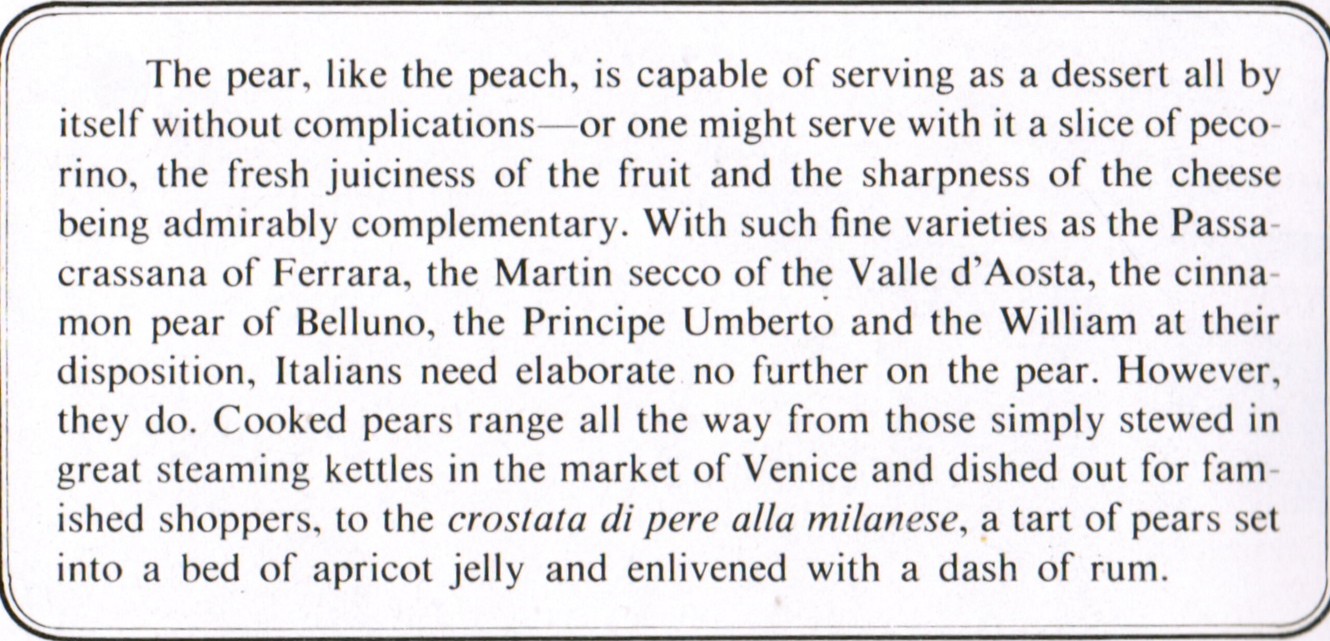
On Labor Day I decided to bring a favorite dessert to our family barbecue on the Nob, as we call Dick Berendt's San Francisco penthouse high atop Nob Hill. Some luscious, ripe Bartlett pears from Bernie's stand at the Farmer's market were beckoning, and though the author Waverly Root suggests serving them as dessert all by themselves, without complications, I visualized a more impressive creation. So I thumbed through the dessert section of his Best of Italian Cooking and rediscovered this timballo (or dessert pie) embedding pears simmered in red wine and spices in a cornmeal crust.

California Bartlett pear season is over, so Bernie poses with one of his apples

 I hadn't made this recipe in years and I was hesitant only because I vaguely remembered that the crust was difficult to roll out and transfer to a pie plate. However, since my pie crust skills have improved significantly, I had confidence that this time I would succeed.


My 1974 copy of the cookbook (first printing)

I propped the book open to page 258, uncorked a bottle of Dolcetto d'Alba, peeled and chopped Bernie's pears, stuffed the cores and peels in my green bin and simmered the chunks of fruit in a mixture of the red wine, sugar and cinnamon. When the pears were tender and syrupy I let them drain while I tackled the crust.

So far, so good

Mixing the cornmeal, flour, and butter in my food processor was routine but, typical of Italian tart crusts, this one called for two eggs, and I added some lemon zest. Then a buzz of the blades while I poured in ice water and the dough came together beautifully. I gathered it into a ball and chilled it hoping for the best.


My favorite heavy wooden rolling pin and an 8" aluminum pie plate ready for the pie dough

An hour passed and the time of truth had arrived. I retrieved my wooden board from the pantry, covered it with flour and began rolling with my heavy wooden rolling pin. Cracks and fissures developed soon after I began rolling but I continued, adding more flour, rotating and smoothing out the dough regularly. Instead of mending together, the large cracks made deeper inroads into the surface, and I knew I was in trouble. I had a messy cornmeal disc that was the correct circumference, so I tried to transfer it to my 8" pie pan. It fell to pieces as I struggled to get a spatula underneath, so I plopped the broken dough bits in the pan and pressed them in, crimping the top edge as well as I could. I knew a pressed-in bottom crust would be fine. But what would I do with the top crust?

I filled the dough-lined pie pan with the pink wine-poached pears and rolled out the second half of my sticky cornmeal dough. Unfortunately, the same cracks developed and stubbornly refused to mend. Even thoroughly floured dough stuck to the rolling pin. I would certainly not be able to get a spatula underneath and cover the pears in one solid blanket of dough as instructed. So I found a square metal cookie cutter, cut out 3" pieces of dough and placed them overlapping on top of the pears. That worked quite well and it seemed to be a good solution. The completed pie didn't look too different from the photo in the book.

I baked the  pie in a 375 degree oven until golden brown and removed it to cool on a rack before it made the trip to San Francisco.

Pear timballo with patchwork cornmeal crust

After dinner we ate slices of the timballo with vanilla ice cream drenched in the sweet winey syrup left over from poaching the pears. The pie was absolutely delicious, and was declared a great success. I guess it was only fitting that I labored a bit on Labor Day


Sunday, September 1, 2013

September's Yoga Cat


                                                             Side Plank Pose
                                   Vasisthasana
                                                            Strengthens arms, belly and legs
                                                             Stretches and strengthens wrists
                                                             Improves sense of balance


Saturday, August 24, 2013

Guillermo the Golden Trout in Richmond


In October 2012 I wrote about the Richmond Farmer's Market. HERE. The blog opened with this colorful fish sculpture, mounted on the Richmond City Hall next to the market.  At the time I could find no information about the fish or its creator. But last  Friday I returned to the outdoor market in the late afternoon when the vendors were packing up and scored with even better deals than ever. One pound of green beans for a dollar, a few jalapenos thrown in for free, and a beautiful, big watermelon for a buck. Then just past the market on my way home, I pulled over to take a call and saw the parking lot of the Richmond Art Center.

I was hopeful that the art center would have information on the huge, brilliant fish sculpture hanging above and directly behind it, so I parked in their lot and went in. As I walked in the door to the gallery, I spotted a plaque with the whole story clearly written, answering all my questions.


Mystery solved, I continued to check out the Center. A friendly employee wearing an artistic silk-screened tee shirt was working in the gallery. He insisted on showing me around. There was a party going on for the childrens' summer program, and after swerving around the food tables, he showed me  all the spacious studios—workshops for metal work, ceramics, printmaking, weaving, and galleries full of artworks.


Artist in the metal workshop (from Art Center catalog)


One of many striking pieces in the gallery


      Opal Palmer Adisa
      I am Sunshine 2008
      Color Photograph 15X10

In all my trips to the neighboring market, how had I missed this wonderful Richmond resource? Happily, I left with a catalog and vowed to tell everyone about my discovery.


When I got home I looked up Andree Singer Thompson and discovered that she is a Berkeley-based teacher and eco artist specializing in communal and international survival issues. She teaches at Laney College and gives workshops throughout the country. You can see her website HERE


Monday, August 12, 2013

Pesto, My Favorite Food


Even before I tried it, I knew I'd love pesto. Basil has always been my favorite herb and the combination of garlic, olive oil, pine nuts and parmesan cheese with aromatic basil leaves sounded  ambrosial. But growing up in a Mid-western meat and potatoes community in the 1950s, no one I knew had ever made it and it was not served in restaurants we patronized. Spaghetti and meat balls was the only pasta dish I was familiar with, and we didn't call it "pasta" until I went to Italy during my junior semester abroad. That was in Florence where pesto (a dish from its rival Genoa) was frowned upon. Tomato based pasta dishes prevailed.

Finally, in my early 30's in California I woke up to PESTO. I had opened my bookstore Cookbook Corner, and paging through The Classic Italian Cookbook by Marcella Hazan, published a few years earlier, I read this beautiful passage on page 139:

     "If the definition of poetry allowed that it could be composed with the products of the field as well as with words, pesto would be in every anthology. Like much good poetry, pesto is made of simpe stuff. It is simply fresh basil, garlic, cheese, and olive oil hand ground into sauce. There is nothing more to it than that, but every spoonful is loaded with the magic fragrances if the Riviera.
     The Genoese, who invented it, insist that authentic pesto cannot be made without their own small-leaved basil and a marble mortar. This is true and it isn't. It is true that Genoese basil is particularly fragrant, partly because of the soil but, even more important, because of the Mediterranean breezes that bathe it as it grows. It is also true that grinding the basil into the marble of the mortar somehow releases more of its flavor than other methods. But, with all this, pesto is such an inspired invention that it survives almost anything, including our minty, large-leafed basil and the electric blender."

My 1977 edition of the Classic Italian Cookbook

The beauty of her prose, the clarity of her directions and the unfailing success of the finished dishes, have always endeared me to Marcella. And even though I know from personal experience— and many other sources— that she can be quite cranky in person, she is unsurpassed as a food writer. Being that her native language is Italian, and she didn't come to this country until  her twenties when she married Victor Hazan, I suspect that he had a great deal to do with the polished and elegant prose in this and all her subsequent books. She certainly lavishes affection and praise on him in many of her dedications. In her Classic Italian Cookbook she writes, "To Victor, my husband con tutto il mio amore e profonda tenerezza."

Basil leaves rinsed, dried and ready to be transformed into pesto

Shortly after I read Marcella's instructions for pesto in The Classic Italian Cookbook, I set out to make my first batch. It sounded so easy: gather the famous four ingredients and grind them to a paste in a mortar with a pestle. I used my smallish French marble mortar and pestle and---

I began grinding basil leaves, olive oil and garlic cloves together. But it was useless. Oil  splattered all over the counter, the leaves refused to form a paste and the garlic slid around the slippery sides of the mortar, refusing to emulsify. I was close to tears, grinding uselessly, then pounding angrily. I couldn't believe the mess I was making. Marcella was no help. So, then and there I left the kitchen and drove straight to my friend Louise's Berkeley kitchenware shop, Cookworks, and bought a Cuisinart food processor. I set it up at home and dumped the contents of the mortar into the bowl, turned it on and in only a few seconds a small miracle occurred. The basil, oil, garlic and pine nuts whirred effortlessly into a lovely smooth green paste.


 Successfully blended pesto in my first Cuisinart

 I poured the unctuous green mixture into a bowl, added Parmesan cheese and admired the finished product. Never again did I attempt to grind pesto with a mortar and pestle, though by now I know that the secret to successful hand-grinding is a large mortar with a sturdy hardwood pestle. These items can be found in most Asian groceries and can also be used to grind Thai red and green curry pastes.

A bouquet of flowering basil leaves left over after making pesto

The recipe is so simple I know it by heart, and only occasionally do I need to look it up in my book.
First I buy a beautiful, fragrant bunch of fresh organic basil at the farmers' market. Then I strip the leaves from the stems and immerse them in a large bowl of cold water. Almost always I find a scattering of dirt on the bottom of the bowl, so I feel rinsing is necessary. I towel dry the leaves, (the only tedious part of the operation,) and throw the stems in my greenbin. Then I measure two packed cups of leaves in a glass measuring cup, dump them in my newer Kitchern Aid food processor, add two chopped cloves of fresh garlic, two tablespoons of either walnuts or pine nuts, a pinch of sea salt, and one half cup of extra virgin olive oil. I then turn on the machine and grind the pesto for a few seconds until it appears smooth, sometimes adding a bit more oil, if it looks dry and moves sluggishly. I pour it out of the food processor into a clean bowl and make a second identical batch. When I've used most of my basil and my pesto is finished, I add one half cup of grated Parmegiano/Romano cheese and hold it until I make my pasta. When the pasta is almost cooked, Marcella directs us to add a small amount of pasta water and a few tablespoons of warm butter to enrich the pesto. I serve the pasta and allow each diner to add his own pesto and more grated cheese.

                                                             Buon Appetito

Fresh spinach fettuccine al pesto on an Italian plate

FEATURED BOOKS


   Marcella Hazan taught Italian cooking classes when she first came to New York from Italy, as a young bride. She then gathered her recipes from all over Italy and wrote them down to try to help American  readers discover the happiness and beauty of the total Italian food experience. This effort resulted in The Classic Italian Cookbook which was published by Alfred Knopf in 1973. The book sold well and took its place in many kitchens throughout America, including mine. But when she finished this beautifully written volume she regretted that "there were still so many wonderful dishes one could do!" The surprising success of the book made her realize that uncomplicated Italian home cooking was exactly what many people wanted. So she wrote More Classic Italian Cooking, which again was published by Knopf in 1978. I have a first edition signed by her when she visited my store in San Francisco on her book tour. I actually prefer this second volume.  The recipes, gathered from nearly every province of Italy seem more creative, the ingredients more vibrant, and the results always superb.

For a sparkling example of Marcella's writing, go to the introduction of The Classic Italian Cookbook and swoon over her poetic style. The section I recommend describes The Italian Art of Eating and begins, "Not everyone in Italy may know how to cook, but nearly everyone knows how to eat. Eating in Italy is one more manifestation of the Italian's age-old gift for making art out of life."


In1992 her two books were gathered into one volume, entitled Essentials of Classic Italian Cooking. They deleted some recipes and added fifty new ones. Wouldn't you know, they eliminated some of my favorites, so I'm happy to own the two originals. One deleted favorite is a recipe for pears cooked with custard and cioccolato. Another is included but is difficult to find because the name has been changed. It's actually a pesto recipe, Picagge col Pesto di Ricotta which inventively directs you to blend a small amount of fresh ricotta cheese into the finished pesto, lightening and refreshing the sauce. The ricotta pesto is then layered with al dente lasagne noodles to create an easy and spectacular dish. Or you can mix the concoction with a pasta of your choice. Both of these creations are from More Classic Italian Cooking.

Also deleted is the inspiring introduction to pesto in the Classic Italian Cookbook, quoted above. Mrs Hazan does, however,  have some new things to say about pesto, which are right on the mark:
    "Pesto may have become more popular than is good for it. When I see what goes by that name, and what goes into it, and the bewildering variety of dishes it is slapped on, I wonder how many cooks can still claim acquaintance with pesto's original character and with the things it does best."
As for me, I'm sticking to the classic version of this culinary masterpiece. I don't want to risk displeasing Marcella, and why mess with perfection?