Thursday, July 29, 2021

Elaine De Kooning - One of the Ninth Street Women


Self portrait of Elaine De Kooning in 1946


Here sits Elaine De Kooning in two self portraits, painted when she was 26 years old. She was the brilliant, talented, energetic and beautiful artist who was the emotional center of a group of creative spirits known as the "New York School."  These were a close knit group of artists, poets, dancers and musicians who lived in lower Manhattan in the 1940s, 50s and 60s.


I've recently been introduced to her in the engrossing book Ninth Street Women by Mary Gabriel. The Berkeley Public Library site offers this summary:

"The rich, revealing, and thrilling story of five women whose lives and painting propelled a revolution in modern art, from the National Book Award finalist. Set amid the most turbulent social and political period of modern times, Ninth Street Women is the impassioned, wild, sometimes tragic, always exhilarating chronicle of five women who dared to enter the male-dominated world of twentieth-century abstract painting--not as muses but as artists. From their cold-water lofts, where they worked, drank, fought, and loved, these pioneers burst open the door to the art world for themselves and countless others to come."

Among the five women artists discussed in the book (De Kooning, Lee Krasner, Helen Frankenthaler, Grace Hartigan and Joan Mitchel), it feels like there is a disproportionate amount of space devoted to Elaine De Kooning, probably because she had the most dynamic personality and the most exciting life. Besides working as an abstract expressionist, she started painting self portraits in the '40s and then went on to become a talented portraitist. Her most famous subject was John F. Kennedy, who sat for her in Palm Beach.  As an ardent liberal, she was captivated by JFK and painted numerous works of him, as seen in her studio below.
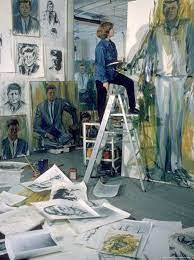


                   A clearer detail from the large painting above. She's still on the ladder painting JFK

Such a fascinating person deserves a more detailed rendering, so I would recommend checking out her bio HERE or better still, reading the book Ninth Street Women


Sunday, June 27, 2021

Bloomin' gorgeous


These brilliant flowers are bee and butterfly magnets 

I bought this local bloom at the El Cerrito Farmers Market on Sunday. It was too stunning to pass up. Negligence in the garden isn't often rewarded, but when left unpicked the edible buds of the artichoke open into spectacular flowers like the one above. I photographed flowering artichokes in 2012 when I had just started my blog and I'm still at it.


Tuesday, June 1, 2021

June is Busting Out in Berkeley


This scene greeted me first thing Tuesday morning


Bali wind chimes ringing in the fog on June 1st


Thursday, March 18, 2021

Primavera for All

It's the Vernal Equinox and Spring has Sprung whether you're a nymph or a cat. Botticelli knew all about it and other's have had some fun with his Renaissance masterpiece known as Allegoria della Primavera or Allegory of Spring, exhibited in the Uffizi Gallery in Florence.

Allegory of Spring by Sandro Botticelli c.1480


My cat Allie's version 


Tuesday, March 2, 2021

Oh Happy Day


                       Two sisters on two coasts complete their two Pfizer vaccines just days apart

                                                           and here are the documents to prove it 


                            And finally on March 12th Dean got his 2nd Moderna shot


Saturday, December 19, 2020

Allie (on right) and friends wishing you a Merry Christmas and Happy New Year


Tuesday, December 8, 2020

President's Compost

The seven Founding Fathers


It's high time for another guest blog and this one, by my sister Lucia Monfried, spotlights four of our revered founding fathers and is entitled      PRESIDENT'S COMPOST

With presidential politics front of mind these days, I'm thinking of a certain president who was hot headed, prickly, and off-putting, one who distrusted the press, and felt himself constantly undercut by comparisons to his predecessor. No– it's not the current resident in the White House, but John Adams, our second president. Comparisons to current leader (ahem!) end there. Adams, who said "facts are stubborn things," was a courageous patriot and brilliant writer and thinker who got the revolutionary war going.

Defeated in the election of 1800 by Thomas Jefferson, his vice president, in a hotly contested and shockingly mean spirited fight, he did not attend the inauguration of his rival, instead slipping away to his farm before the festivities. Sound like someone we know?

I gleaned these facts from a wonderful book called Founding Gardeners by Andrea Wulf, about the estates, farms and gardens of our first four presidents.


As election tensions rose in the leadup to the recent election, I found a kindred spirit in Adams, who was reputed to go out "digging and scything" when he felt anxious as Washington's vice president.


Madison couldn't wait to don old patched trousers for gardening, while I wear sweatpants and old shoes today

I indulged in some digging and raking (not scything) myself, in my garden in Connecticut, to ease my anxiety as events unfolded in November.

Adams was the only New Englander among the founders Washington, Jefferson and Madison, all rich Virginia estate owners. Adams had a farm in Quincy, Massachusetts, which he named Peace Field (now a part of the National Park Service and open to visitors in normal times) to which he retreated and lived out his very long life.


Peace Field in Quincy, MA


 Below, in contrast to John Adams's modest farm, are depictions of the grand Virginia estates of George   Washington and Thomas Jefferson. 


Extensive gardens and grounds of Mt. Vernon, George Washington's estate in Northern Virginia


Monticello, Jefferson's luxurious estate in central Virginia- note extensive experimental 'vegetable terrace' to the right


Adams eventually reconciled with his former friend Jefferson with whom he had spent time in England after the Revolutionary War carrying out governmental duties. They both toured gardens there, read treatises, and immersed themselves in the art and science of horticulture.

Both men believed deeply in an agrarian future for the young republic, and followed advances in agricultural research.  Endearingly to me, Adams studied and revered compost. One scene in the HBO miniseries John Adams starring Paul Giamatti as Adams and Laura Linney as his wife Abagail, shows him in the muck extolling the merits of manure.


Promotional photo for HBO's John Adams


A screen grab of young John Quincy Adams 

                "Deeper! Deeper!"commands John Adams while he and his son dig in the compost                                                                           in the HBO miniseries John Adams


                  Son John warily sniffs a handful of dung offered by his enthusiastic father in John Adams.


Adams may have been truculent and thin skinned but he reminds us that people are complex, a mix of attractive and unappealing characteristics. Another reminder: activities that were sustaining two centuries ago– digging and composting and improving the earth– continue to be so today. Working on his farm was so important to Adams that he compared it to a medicine.

So with this wish, take a cue from John (and James and George): May the conservation of the land so hallowed by our founding fathers sustain us all in this fractious time of transition.