Tuesday, February 11, 2014

In Defense of Bread

Bread, traditionally known as the staff of life, is now public enemy # 1. It's under attack from all sides. Many Americans, some of whom are having trouble digesting wheat, are now espousing a gluten-free regimen (which forbids wheat), and the Paleo Diet, which eliminates bread altogether. But let it be known that I'm holding my ground amidst the growing number of nay-sayers. I'm a carb lover—I still eat bread, pasta (made with wheat flour and eggs,) whole grain cereal, muffins, cookies, and more, and I feel fine!


  My friend Anna, artist and soup-maker,  sent me an interview with Michael Pollan which originally appeared as a podcast on "Inquiring Minds." In the interview Mr Pollan—best selling author and agricultural activist—debunks the Paleo Diet and offers five concrete suggestions for eating healthfully. Below, I've printed suggestion #2, which speaks about the healthful aspects of my topic, bread.

2." Humans can live on bread alone. Paleo obsessives might shun bread, but bread, as it has been traditionally made, is a healthy way to access a wide array of nutrients from grains.
In Cooked, Pollan describes how bread might have been first created: Thousands of years ago, someone probably in ancient Egypt discovered a bubbling mash of grains and water, the microbes busily fermenting what would become dough. And unbeknownst to those ancient Egyptians, the fluffy, delicious new substance had been transformed by those microbes. Suddenly the grains provided even more bang for the bite.
As UC-Davis food chemist Bruce German told Pollan in an interview, “You could not survive on wheat flour. But you can survive on bread.” Microbes start to digest the grains, breaking them down in ways that free up more of the healthful parts. If bread is compared to another method of cooking flour — basically making it into porridge — “bread is dramatically more nutritious,” says Pollan.
Still, common bread made from white flour and commercial yeast doesn’t have the same nutritional content as the slowly fermented and healthier sourdough bread you might find at a local baker. Overall, though, bread can certainly be part of a nutritious diet. (At least, for those who don’t suffer from celiac disease.) "    

      I was introduced to good bread by my mother, who started baking her own loaves in the 1950s when she couldn't find delicious, healthy bread in Milwaukee. Wonder Bread was ubiquitous at that time, but somehow she discovered the recipe for Cornell bread, developed by Professor Clive McKay at  Cornell University's Dept. of nutrition, and she started baking bread regularly. Her loaves, with healthful additions of soy flour, wheat germ and dry milk, emerged from the oven yeasty and fragrant. But truth be told, my sister and I preferred packaged white "cardboard" bread for our sandwiches. What did we know?

Even when I moved to Berkeley, except for the famous crusty San Francisco sourdough loaves from commercial bakeries like Toscana and Colombo, it was difficult to find good bread; so I followed in my mother's footsteps and started baking my own.

The Complete Book of Breads by Bernard Clayton, 1973

Luckily, Bernard Clayton, a writer and editor in the Business School at Indiana University, had just published his Complete book of Breads. Baking my way through his well-organized roster of recipes kept me busy and well-fed for a decade. At that juncture, bakeries were springing up that satisfied my particular standards. In 1976 Joe and Kass Schwin started grinding whole wheat flour and producing healthy, 100% whole-wheat loaves at their mill in Berkeley; they named their company Vital Vittles. They later sold the bakery to faithful employees, and the bread is as good as ever. I especially like the three-seed and the flax-seed oat breads.  


During the '80s I read rave reviews about the bread made in Paris by Lionel Poilane. On a trip there, I made a special effort to visit the boulangerie at 8 Rue du Cherche-Midi to sample the "Miche," their signature loaf,  and the beguiling apple tarts hot from the oven. I was very impressed and have remained a life-long devotee. The Poilane ovens and boulangerie are in the fashionable sixth arrondisement. When I visit Paris I always stay near the bakery, at Hotel de Sevres, a quaint little hotel I found while wandering around the quartier that first magical time. I still like to pick up breakfast goodies from Poilane every morning— just add cafe au lait and I have the perfect petit-dejeuner

Poilane at 8 Rue du Cherche-Midi, Paris
The signature Miche Poilane

 Times have changed here in the Bay Area and throughout the US as a swell of artisan bakers are busy producing fabulous breads that equal those of Poilane in Paris. Husband and wife team Chad Roberts and Elisabeth Prueitt traveled to France after graduating from culinary school and studied with French bakers to master breadmaking in the Poilane tradition. When they returned home they chose Point Reyes Station, CA to build a wood-fired oven and bake bread. They first sold Chad's bread and Elisabeth's pastries at the Berkeley Farmers' Market where I was lucky enough to encounter them. Immediately, I was smitten. The chewy, sour, tangy loaves with a spectacular crackly crust were unsurpassed. In 2002 the couple opened Tartine Bakery in San Francisco's Mission District and the combined bread bakery, pastry shop and cafe was an instant success. They have now added a sandwich shop and written three books. There are always long lines for their superb products at Tartine.


http://tartine-bread.blogspot.com/2014/01/guest-baker-chad-robertson.html

  I could rhapsodize at length about the quality and depth of flavor and texture of Bay Area breads but I think I will just list my personal favorites. One bite into a warm, crusty slice is worth a thousand words!


Tartine Bakery's country loaf in all its glory

Phoenix Pastaficio's olive loaves gleaming in the sun at The Berkeley Farmers' Market
Another personal favorite  is the olive bread from Phoenix Pastificio in Berkeley. They sell their  pastas, pastries and olive bread at farmers' markets in the area.

I can't get enough of the delicious olive bread from Phoenix Patificio


Epi baguettes from Acme Bakery owned by Chez Panisse baker Steve Sullivan


Seeded sourdough baguettes at the Cheese Board in Berkeley

My sympathy goes out to friends like Hali, Lee and Lynn who can't tolerate wheat and many other substances without extreme discomfort. But I have noticed that the gluten-free contingent is growing by leaps and bounds and is now well represented both on the web and in the marketplace. Thus, I feel compelled to weigh in on the side of wheat and share my love affair with bread.


Monday, January 13, 2014

Spring Cleaning in January


 Monday evening when I opened the garage door, this pile of overflowing plastic garbage bags greeted me.  I should preface this by saying that my father-in-law Myron died peacefully in his house in August at 92. His caregiver left without cleaning, so finally lovely Dixie, the trustee's assistant, was good enough to clean out the freezer and kitchen cupboards. She placed everything into these large plastic bags and left  them in the garage hoping I would dispose of them. She fully expected me to dump the bulging bags into the trash, but being the avid recycler that I am, I took up the challenge and decided to separate the contents and dispose of them properly.
The next morning I tackled the recycling project. Curious about how much room the contents of all seven full garbage bags would actually require, I set to work unpacking, "unpackaging" and separating each item into its simplest form. This would be fun!

Bags of Kasha and Ghanaian Prekese

There was some good stuff: bulk bags of kasha, prekese, which is a sugar cane product from Ghana (used by the Ghanaian caregiver), brown and jasmine rice, whole wheat pasta, bulk walnuts and almonds. All of these were rancid and I tossed them into the green bin. Even the healthy food was packaged in plastic bags and had to be extracted before the final toss. One whole bag was filled with fiddle-leaf fig leaves that had fallen from the indoor plant due to lack of water. That was an easy one.


garbage bin full of bad stuff

There was bad stuff:  processed junk food, invariably packaged in plastic bags and containers. All but the actual food went into the garbage. Myron was an inveterate shopper at Costco and, unfortunately, almost all the products at Costco (and also Trader Joe's) are packaged in various types of plastic. None of this information is earthshaking or even original, but it isn't often that I must discard this quantity of junk food in my own back yard. It is sobering to see how far we are personally, as a community and as a nation, from "zero waste." I resolve to do better. First I intend to find cloth bags to replace the plastic bags I still use and reuse.


Plastic yogurt containers, all recycle level 5, ready to be taken to Whole Foods

Then there was good stuff in bad containers: Yogurt! Those hard, impermeable containers are the  prime offenders. Marked "5" in the triangle on the bottom, they are bothersome to discard because they aren't supposed to be combined with recyclables marked "1" or "2". I go through about two quart containers of yogurt per week. Where should I discard them?
Because Straus Family Creamery in Petaluma packages their milk in glass bottles, I emailed them asking if they could also package their yogurt in glass.  Here's their reply:

"Thank you for your email, we appreciate your inquiry and your kind comments. Unfortunately, our current facility is unable to accommodate yogurt in glass. We simply do not have the space for another piece of equipment. In addition, we ship our yogurt much further than we do our glass milks - therefore if we had our yogurt in a glass container it would cost us more to ship it, then costing the customer more for the product. We do hope one day we can offer a glass option locally - but we will need to build a new creamery first.

As far as our current container - we unfortunately have no way of getting them back from you, however there is a program out there called Gimme 5, by the company Preserve and they will turn the #5 containers into toothbrushes, etc. You can find out more about that program 

We are in the talks with a local toy manufacturer that makes green toys out of recycled yogurt cups. It might be a while before it's set up, but it's something we are trying to set up. Keep checking back with us!"     

         Whole Foods markets, bless them, have bins that take the plastic containers marked "5".

Whole Foods bin just for  "5" recycling
 After trucking all our yogurt  (and cottage cheese) containers across town to Whole Foods, I had completed my project. Miraculously, when deconstructed, the entire collection of white garbage bags didn't  begin to fill our three curbside bins.

Paper compartment not even full of cardboard snack packaging

garbage bin full of junk food and plastic packaging 


Montage of fiddle-leaf fig leaves, guacachips and popchips covering only the very bottom of the curb-side green bin

And then there was one last item to be dealt with. It was an old cardboard box of musty sheet music used by my late mother-in-law Ros, who was a talented pianist. This was all paper and perfectly recyclable, but of course I didn't toss it out.

 German sheet music for Beethoven piano concerto #2


Wednesday, January 1, 2014

CHAMPAGNE CORK


                                              Greenbin starts 2014 with a bang!

(Maybe you didn't know that cork is compostable)

Tuesday, December 31, 2013

Friday, December 27, 2013

Romany Hash

Lists abound for end-of-year favorites, i. e. movies, books, theatre or whatever. So here's my favorite cookbook for 2013.

Bacon 24/7 by Theresa Gilliam, Countryman Press, 2013

Certainly an odd choice, given that my last post was about Vegetarians,  and Deborah Madison came out with a wonderful new book titled Vegetable Literacy.  But this one struck my fancy, and there you have it. Bacon 24/Seven has beautifully artistic photographs by EJ Armstrong with Theresa Gilliam's appealing recipes. I'm sure my vegetarian friends can find substitutes for the bacon in most recipes, so they won't miss out. I'd love to hear their ideas for "Bacon-wrapped stuffed dates."


What really got me started was this picture of a twice baked potato.

 "Baked potato Skins"  photographed by EJ Armstrong in Bacon 24/7

Memories of a version called Romany Hash flooded over me. My mother made these stuffed potatoes when we were growing up and we loved them. I didn't have the recipe so I cruised the internet for anything called "Romany Hash," and came up empty-handed. There are listings for "Romany," which means gypsy, but no hash.  Most recipes from the 1950s yield many responses on Google, but not this one. 


 I decided to check my mother's old metal recipe file one more time. This is one of my prized possessions, containing all my family's favorites, hand-written by my mother. Just the sight of her handwriting fills me with nostalgia and longing.

And—voila!—under the worn tab "Leftover Meats" was the slip of paper with the penciled recipe for Romany Hash. How had I missed it? I have no idea where she found the original; sometimes she cited a source or included a magazine clipping, but where she found this one remains a mystery. 

I remembered most of the ingredients, but had forgotten the bacon fat, which makes it perfect for this post. She put the potatoes through a ricer, one of her favorite tools and, If I'm not mistaken, she said to "anoint" the potatoes with bacon fat—a surprisingly poetic phrase for a practical Mid-western woman!


The reverse side of the recipe concludes with instructions to add bacon fat and butter, refill the potato skins with the filling and dot with paprika, and, after "anointing" the skins with bacon fat, bake in a moderate oven 15 to 20 minutes until heated through. This makes a delicious and savory main course, perfectly completed with a green salad.

The "baked potato skins" in Bacon 24/7  includes ranch dressing, cheddar cheese, and bacon instead of ham. This variation may be tasty, but I'll stick with my mother's Romany Hash.

Another tempting recipe from the book is "Brussels Sprouts with bacon, lemon and honey." My mother never added anything like bacon to her sprouts, she just steamed them and served them with butter, salt and pepper. Now it's the fashion to dress them up with vibrant seasonings or nuts or roast them with other veggies—I like all these variations.


Brussels sprouts with lemon and honey from Bacon 24/7


Recipe by T. Gilliam from Bacon 24/7,


                             Two more favorite cookbooks from 2013 will satisfy vegetable lovers

Deborah Madison, Vegetable Literacy, Ten Speed Press, 2013


Drew Ramsey, M.D.,  Fifty Shades of Kale,  HarperCollins, 2013


Friday, December 13, 2013

Anna's Soup

My friend Anna works with me at Book Passage in the Ferry Building, or should I say I work with her. As one of the the newest members of the staff, I depend on her advice and help, and she is always there for me. Anna is a vegetarian and she claims that she doesn't like to cook. Her husband Dave, who also works with us at the bookstore, does most of the cooking. He too is a veggie man and a great cook according to Anna.  I'm always curious about their vegetarian menus, since I often depend on chicken, or even meat to supply my proteins. He even packs a lunch for her. That's a faithful husband!

The one dish Anna likes to cook is soup, and Dave agrees that she's a pro. But when I questioned her about her soup recipes she looked at me with surprise and informed me that soup is a dish that you make by foraging in the fridge. Rather than checking cookbooks, researching recipes, going to the store to buy ingredients, (steps I do routinely), she takes the opportunity to empty the fridge of leftovers to create a soup that's different every time.

Inspired by Anna's creative spirit (did I mention that she's an artist? ) I decided to try a soup with ingredients I had on hand. And because it was the Monday after Thanksgiving, I had an advantage. The fridge was loaded with beautiful fresh vegetables and holiday leftovers, so I took them out and got to work chopping on my cutting board. What a treasure trove of produce for my impromptu soup!

Shallots, leeks, fennel, carrots, celery, Ricki's wild rice & mushroom stuffing, canned garbanzos and fresh herbs 

Stuffing Soup

 In olive oil I sauteed two chopped leeks and three shallots, added two chopped carrots, two stalks of celery and a half bulb of fennel. When the veggies gave off a lovely, fragrant aroma I poured in some TJ's chicken broth which I always try to keep on hand, and brought it to a boil. After about twenty minutes I added the leftover mushroom-and-wild rice stuffing, thoroughly rinsed garbanzos, and fresh herbs from my garden. Again I let the mixture simmer for half an hour and my soup was done.


Vegetable Stuffing Soup in a vintage Dansk casserole 

We enjoyed the reheated soup for dinner and I held off adding the leftover turkey Ricki had packed for us on Thanksgiving. This way we could enjoy a truly vegetarian meal (oops, except for the chicken broth) created entirely from on-hand ingredients, a la Anna. I can't wait to do it again!


Thursday, December 5, 2013

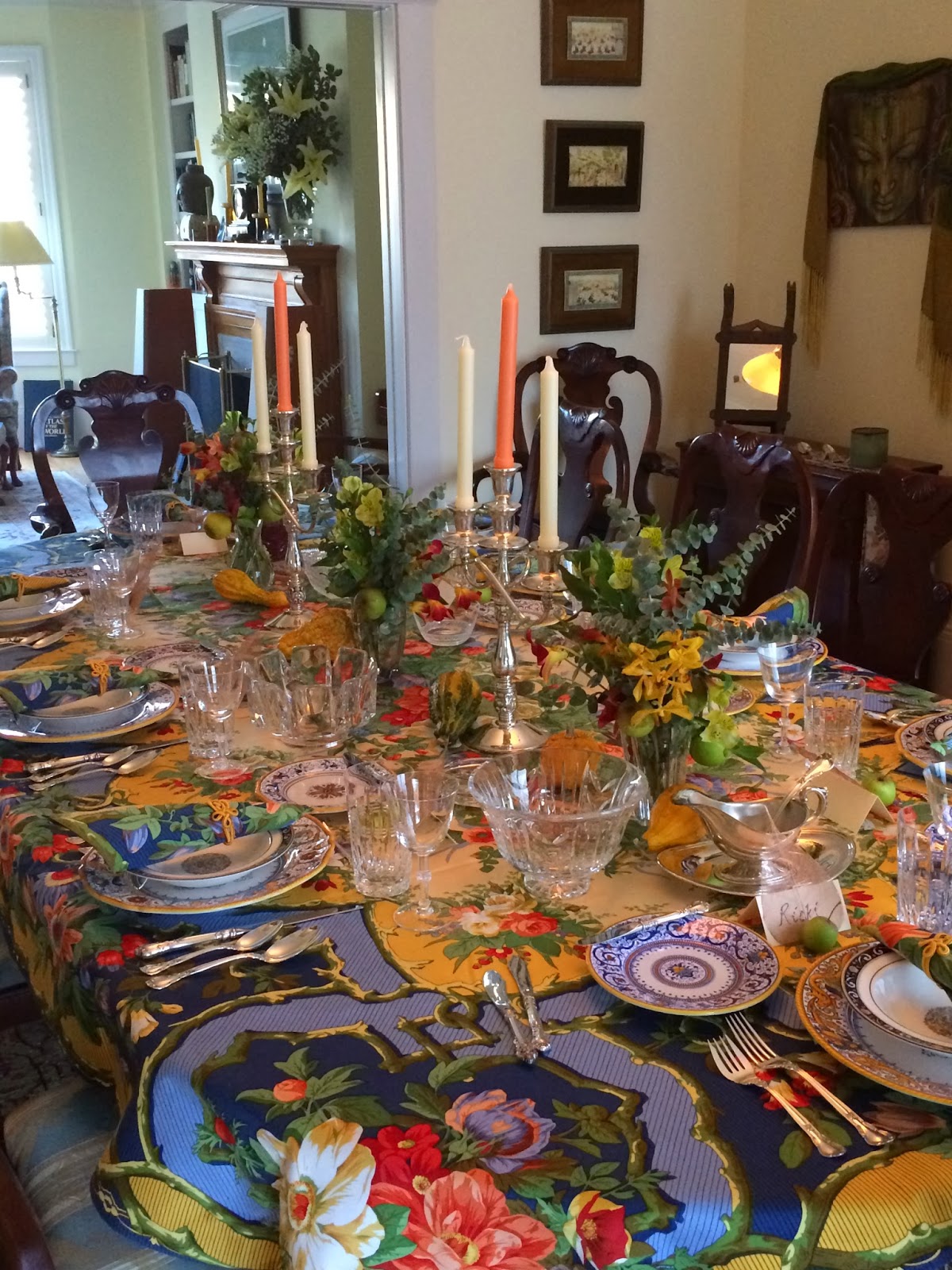
Thanksgiving Table 2013


Thanksgiving 2013 was held as usual at Ricki's in San Francisco. She's my sister-in-law and she always sets a spectacular table. But this year she outdid herself, maybe because Leah, my niece, lent her expertise to the project. Every detail was delightful. Take a look at my personal place-setting and keep in mind that these loving touches were replicated at everyone's seat.

My place setting

Thanksgiving dinner was the traditional groaning board of old favorites and new experiments. Many talented chefs contributed to the effort. However, right now I won't sully the artistry of the table with those details. Let Ricki and Leah's beautiful creation last forever in these images. And please, click on the individual photos for a better view.